
more than human kin
more than human kin
FROM SARAH:
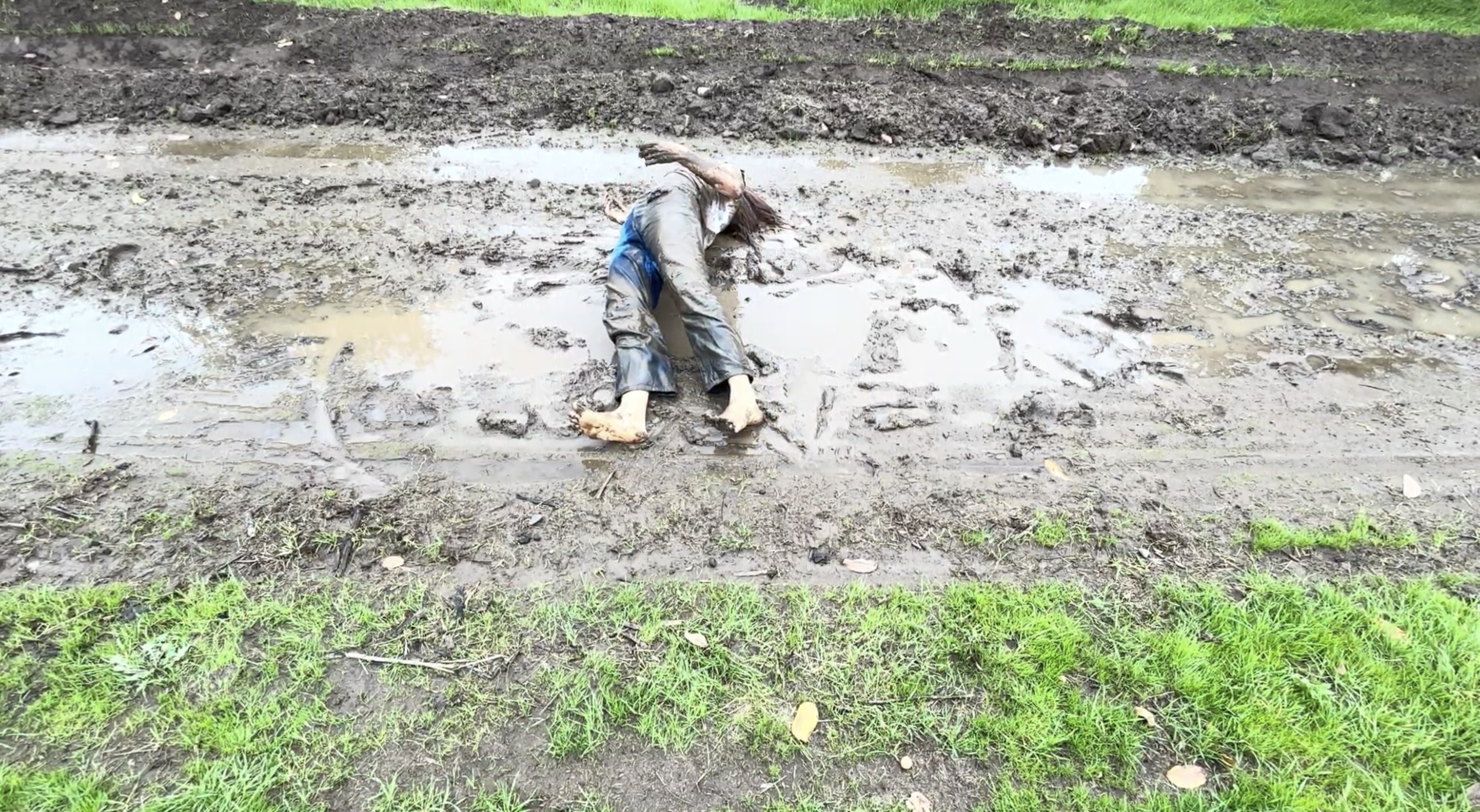
I have been working with salt, cardboard, and mud as some of my practice partners in the last six years in co-bodying the grief of white supremacy.
My current partnership with mud is all about the mucky complexity of anti-racisting–not trying to simplify it, but let it be messy and opaque. As a personal and shared practice, MUD MOVES involves noticing and touching mud every time I encounter it, treating it as a message to get close to (my) racism. At other times, MUD MOVES invites me to slow down to the pace of mud: to learn about the histories of racism and colonialism of the particular muddy place I inhabit, and to dance with the mud and its lessons. I’ve also taken to making mud in a coffee cup and bringing it with me, using it as a support partner in nervous system regulation when I confront racism in me and around me. Mud is a medium: Upon first contact, it offers a memory, a lesson, or a reminder of where I am in my own mud of anti-racisting. Recently, I’ve been writing about mud as a principle of place, as a guide in anti-racisting, and as an archive of my own family’s history with slavery:
This way of being with time and place, mud as time, mud as place, mud as archive helps me be with the complexity of racism as a white person, both in general and about racism and place. Racism itself is mud - a mixed stack of ghosts and living beings. The racial harm of the past fuses itself into the structural and somatic present and threatens the future. Anti-racisting archives work in the same way, muddy stacks of movements and stillnesses imperfectly resisting white supremacy. Mud, then, real mud in and of a particular place, is a vertical archive of racisms and anti-racisms, simultaneously. Our being in/of/with racism and anti-racisting is a pile built of different stages of decaying and becoming alive -a process of complicity and connectivity making mud of us all.
FROM KAI:
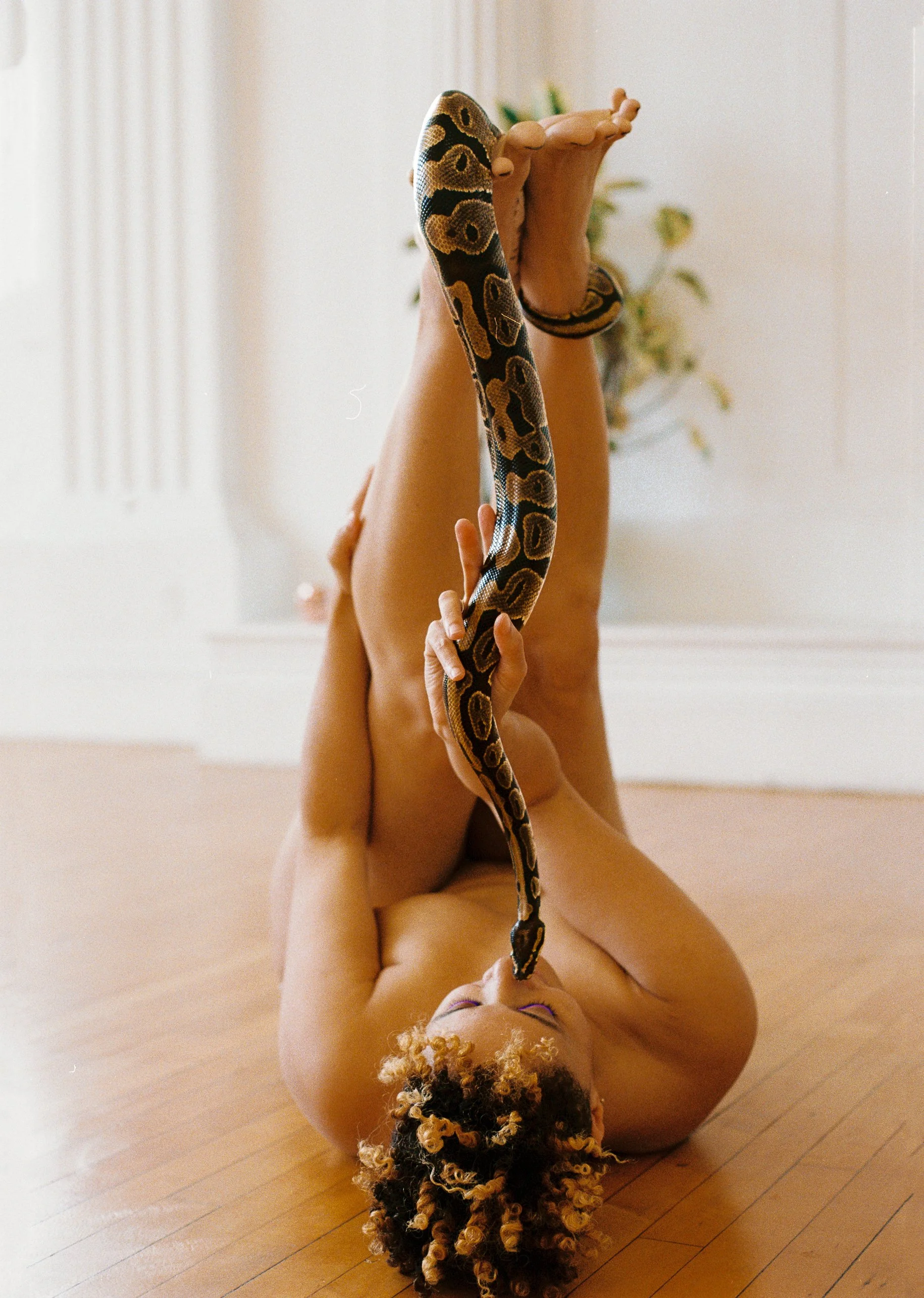
My work over the last 6 years has been guided by snakes, or our Snakecestors as I call them.
Shedding began as observations from my sick bed, continued with experiments of embodied healing practice, and now serves as a framework for moving and making. Liberation is a technique, and I’m learning mine from snakes: their capacity to move in any direction at every moment, the slowness they remind me to play with, their capacity to be in a constant state of transformation and yet be fully themselves at any moment, their shedding, and their constantly becoming and unbecoming, living peacefully in perpetual apocalypse.
When I embody the wisdom of our Snakecestors, I move my body into liberation. With Practice Progress participants, I explore the millenia-spanning slowness of snakes through embodied experiments into reptile time, reptilian breathing, and reptilian-inspired relation to the earth and each other. We ground our bodies, care for our nervous systems, and sense each other to connect more deeply, in order to survive white supremacy and how it impacts the bodies of racialized people.
“We can’t grieve alone. It's too big. The water, the trees, the sky can be our partners, to co-hold the big grief. It’s reciprocal offering, to be grief partners with the natural world.”
- devynn emory, lenape/blackfoot choreographer and covid hospice nurse, speaking on their grief project deadbird
“Perhaps we find in this ‘language of the trees’ the interesting proposal that the racializing agent is not singularly human or just a social construction but a flow of material-semiotic practices that engulfs/shapes/constitutes humans together with trees, stones, stories, concepts, and the world. Perhaps the world around us, the environment, pulses with the question of race.”
- Bayo Akomalfe, I want my skin to breathe, 2017
“And my first marine mammal lesson was that if I breathe I can still speak even while crying. I can breathe through salt water. I can live through this mess.”
- Alexis Pauline Gumbs from Undrowned: Black Feminist Lessons from Marine Mammals
“Biomimicry is this idea of us studying the ways that nature and biology have gone about solving different challenges… I love knowing that the practices of mimicking the natural world have been happening since humans came into existence. This is actually an ancient practice, a recovery rather than a discovery.”
- adrienne marie brown, from her book Emergent Strategy